

Women's Bowler Hats: History, Significance, and Style
Women's Bowler Hats: History, Significance, and Style
The bowler hat was built for men who rode horses through Norfolk woodland in 1849. It was not built for women, and nobody at Lock & Co. Hatters imagined it would end up on the heads of Bolivian market traders, 1980s pop stars, or fashion week attendees. But that is exactly what happened, and the story of how women took a practical gamekeeper's hat and turned it into a fashion staple is worth telling properly.
Why Do Women Wear Bowler Hats?
Two reasons keep the women's bowler hat in wardrobes year after year. The first is cultural. In Bolivia, Aymara and Quechua women have worn the bombin since British railway workers brought it to South America in the 1920s. The hat became a marker of identity: worn centred on the head by married women, tilted to one side by single women. It stopped being a British import and became a Bolivian tradition within a single generation.
The second reason is visual contrast. A structured, hard-crowned bowler hat sitting on top of a soft wool coat or a printed midi dress creates a tension that reads as intentional. The hat provides the sharp line; the clothing provides the movement. That combination is why the women's bowler hat keeps returning to street style, autumn lookbooks, and race day outfits — it does a job that softer hats cannot do.

How Women Claimed the Bowler Hat
The bowler hat, also known as a Coke hat, billycock, or derby in the United States, was designed by Thomas and William Bowler for Lock & Co. in 1849. For its first seventy years it belonged to male gamekeepers, City of London bankers, and American railroad workers. Women were not part of the picture.
That changed in Bolivia first. When British workers arrived to build railways in the 1920s, they brought bowler hats with them. A shipment arrived in the wrong sizes — too small for the men they were intended for — and a local trader convinced indigenous women that the hats were the latest European fashion. Whether that origin story is precisely true or partly legend, the result is real: Bolivian cholitas have worn bowler hats for over a century, and the tradition shows no sign of fading.
In Western fashion, women wearing bowler hats gained traction in the 1970s and 1980s. Liza Minnelli wore one in Cabaret (1972), creating one of cinema's most recognisable hat moments. Annie Lennox wore bowlers as part of the Eurythmics' androgynous visual identity. By the time Janelle Monáe adopted the style in the 2010s, the women's bowler hat had moved from counterculture statement to a legitimate fashion choice that needed no justification.
Notable Women Who Wore Bowler Hats
- Bolivian cholitas — Aymara and Quechua women who turned a European import into a cultural tradition. The position of the hat on the head signals marital status.
- Liza Minnelli — The Cabaret bowler hat look (1972) remains one of the most referenced women's hat images in film.
- Annie Lennox — Wore bowler hats throughout the 1980s as part of the Eurythmics' performance style, making it acceptable for women to wear traditionally male headwear on mainstream stages.
- Janelle Monáe — Brought the bowler into 21st-century pop culture as part of her black-and-white aesthetic.
- Vivienne Westwood — Featured women's bowler hats in multiple collections, connecting punk fashion with British heritage millinery.


What Are Women's Bowler Hats Made Of?
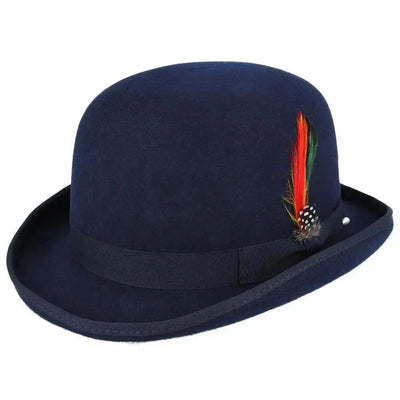
The material is what separates a real bowler hat from a costume piece. Traditional bowler hats are made from wool felt that has been stiffened with shellac — a natural resin — to create the hard, dome-shaped crown that holds its shape permanently. That stiffening is what makes the bowler structurally different from softer wool felt hats like the fedora or trilby, which can be pinched, creased, and reshaped by the wearer.
The entire Novella Hats bowler range uses 100% wool felt. Higher-end historical bowlers from the 19th and early 20th centuries used fur felt (beaver or rabbit), but wool felt is the standard for modern production and provides the same dome rigidity at a lower price point. The interior is fully satin lined with a sweatband for comfort during extended wear.
Bowler Hats vs. Derby Hats
They are the same hat. "Bowler" is the British name, taken from Thomas and William Bowler who built the first prototype. "Derby" is the American name, borrowed from horse racing — American gentlemen wore bowler hats to the Kentucky Derby and the name stuck. The crown height, brim width, and construction are identical. For the full naming history, see the bowler hat vs derby hat comparison.
How to Style a Women's Bowler Hat
The bowler hat works because of contrast. The rigid dome and curved brim are the most structured elements in any outfit, which means the clothing around it can be softer without looking shapeless. Here are four combinations that work in practice:
Tailored coat + ankle boots: The sharpest pairing. A black or burgundy wool felt bowler over a fitted wool coat, slim trousers, and leather ankle boots. This works for autumn race days, formal outdoor events, and structured weekend outfits. The bowler replaces a scarf or statement necklace as the finishing piece.
Midi dress + bowler: A dark bowler over a printed or floral midi dress is the outfit that gets photographed at weddings, garden parties, and festival VIP areas. The dress provides flow and pattern; the hat provides the anchor point. This works best with a bowler in black, navy, or burgundy rather than a colour that competes with the print.
Leather jacket + straight-leg jeans: This is the everyday version. The bowler hat adds a point of character without making the outfit feel like a period costume. Keep the rest simple — flat boots, a plain top, minimal jewellery — and let the hat do the talking.
Steampunk and themed events: A bowler with a waistcoat, high-waisted trousers, and a watch chain. The bowler's Victorian origins make it one of the few hats that works at steampunk events without looking like a costume prop, because it is a genuinely historical hat shape. For themed occasions, the women's top hats collection at Novella Hats also carries Victorian junior top hats from $29.99.
For a guide on which hat shapes suit different face types, see hat styles for face shapes.
Not sure which bowler hat to start with?
The Soft Bowler Derby in Black is the most versatile option — it pairs with coats, dresses, and casual outfits equally well. 100% wool felt, satin lined, sizes S/M and L/XL.
See the Black Soft Bowler — $39
Women's Bowler Hat Sizes
Getting the size right matters more with a bowler than with softer hats. Because the crown is stiffened, a bowler that is too large will sit on your ears, and one that is too small will perch on top of your head rather than sitting properly at brow level. Measure around the widest part of your head, just above the ears, with a flexible tape measure.
The Novella Hats bowler range runs from XXS (52cm) to XL (62cm). Most women fall in the S/M range (55-57cm). If your measurement falls between two sizes, go with the larger one — the internal sweatband will take up the small difference. For full sizing details with UK, US, and EU conversions, see the Novella Hats size guide.
Caring for a Wool Felt Bowler Hat
Brush the hat after each wear with a soft-bristled hat brush, working in gentle circles around the crown. For spots or marks, dampen a clean cloth and blot — do not rub, as rubbing can push dirt deeper into the felt fibres. Store the hat upside down on its crown or on a hat stand that supports the dome from inside. Keep it away from direct sunlight and heat sources, which dry out the felt and can crack the shellac stiffening over time. For a detailed walkthrough, see the wool felt hat care guide.
Frequently Asked Questions
Can women wear bowler hats?
Yes. Women have been wearing bowler hats since the 1920s in Bolivia and since the 1970s-80s in Western fashion. The bowler's rigid structure creates a strong visual contrast against feminine styling, which is the reason it works rather than a reason it shouldn't be worn.
What outfits go with a women's bowler hat?
Tailored coats with ankle boots, midi dresses, leather jackets with straight-leg jeans, and steampunk or Victorian-themed outfits. The consistent principle is contrast: the hat provides rigid structure, so the rest of the outfit should be softer or more relaxed.
What size bowler hat does a woman need?
Most women need a S/M (55-57cm circumference). Measure around your head just above the ears with a flexible tape. The Novella Hats range covers XXS (52cm) to XL (62cm). See the size guide for conversions.
Are bowler hats still worn in 2026?
Yes. The women's bowler hat appears regularly in autumn street style, at Royal Ascot, and in designer collections. Burgundy and teal bowlers have gained traction alongside the classic black.
Is a women's bowler hat the same as a derby hat?
Yes. "Bowler" is the British term and "derby" is the American term. The hat is identical. See the full bowler vs derby comparison.
How do I look after a wool felt bowler hat?
Brush after each wear, store upside down or on a stand, keep away from heat and direct sun. See the full hat care guide for step-by-step instructions.
Conclusion
The women's bowler hat started as something it was never meant to be. Edward Coke ordered a hat for his gamekeepers in 1849, and within a century Bolivian women had turned it into a cultural symbol, Liza Minnelli had worn one in a Berlin cabaret, and Annie Lennox had used it to redraw the line between masculine and feminine on a concert stage. That is a hat with a genuine story behind it — not a passing trend that arrived from nowhere and will disappear next season.
The full women's bowler hats collection at Novella Hats starts at $27.99 in wool felt with free worldwide shipping.
Bowler Hat vs Derby Hat: Are They the Same Thing?
The Timeless Appeal of Cowboy Hats: From Western Icon to Modern Fashion Statement
Related Posts

Harris Tweed Flat Caps & Newsboy Caps: The Ultimate Autumn-Winter Style Guide

Best Top Hat Styles for Women: From Victorian to Modern Fashion

Women's Pork Pie Hat: Vintage Chic Flat Crown Felt Cap Guide

Men's Pork Pie Hat: Retro Flat Crown Brim Cap Styling Guide

Women's Trilby Hat for Summer: Light and Stylish Looks

How to Wear a Trilby Hat with a Suit: Men's Smart Style Guide

The Complete Fedora Material Guide: Wool Felt, Straw and Panama
